
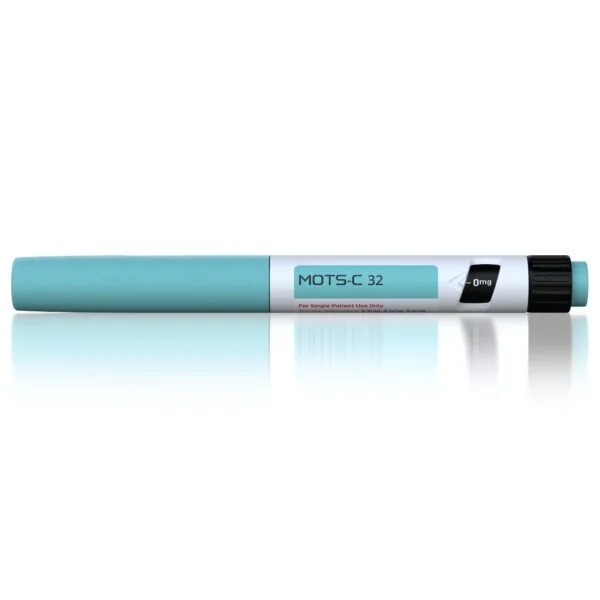
Longevity and metabolism research working with MOTS-c, the mitochondrial-encoded peptide.
- 1 × pre-filled multi-dose pen
- Full instructions
- Tamper-evident verification seal
- 8 × sterile needles
Body Pharm MOTS-C 32mg
Official Body Pharm store — genuine product, batch-tested
Multi-dose injection pen with 32 mg of MOTS-c. Mitochondria-encoded peptide for subcutaneous injection. Exclusively for research and analytical purposes.
- Lab-tested batch with full traceability
- Sealed pharmaceutical-grade packaging
- Discreet, insured shipping within Spain
Add 4 more pens and you get 10 % off. Any mix of pens counts.
Shipping to Spain only. If you are buying from another country, use the UK, German, Czech or EU edition — the links are at the end of this page.
Reviews of MOTS-C 32
Verified reviews from Body Pharm research customers.
Amazing product. It arrived quickly. Absolutely love it.
The Body Pharm MOTS-C 32 mg peptide pen is a pre-filled multi-dose pen designed for subcutaneous injection, holding 32 mg of MOTS-c in total within a 3 ml cartridge, and it is supplied solely for the purposes of laboratory research. The dial sets the dose directly in milligrams. Every batch can be traced back to an HPLC purity analysis that is aligned with the ISO/IEC 17025 standard, and it is shipped as pure research material that holds no authorisation. A total content of 32 mg is enough to cover an extended preclinical protocol from one single sealed cartridge.
MOTS-c itself is a mitochondrial-encoded peptide of 16 amino acids, which was first characterised by Lee et al., Cell Metabolism, 2015 [1], and described by Reynolds et al., Nature Communications, 2021 [2], as an exercise-induced regulator of AMPK signalling and of metabolic homeostasis. This article deals with the mechanism, with the storage and stability profile of the pen, with the documentary chain for the batch and with the regulatory framing under which this product is sold for research purposes.
MOTS-c pen: what you need to know
- MOTS-c is a 16-amino-acid mitochondrial-encoded peptide which, in preclinical models, activates AMPK signalling together with pathways of metabolic homeostasis.
- The pre-filled pen carries 32 mg of MOTS-c in total and its dial sets the dose directly in milligrams, from a single sealed 3 ml cartridge.
- Every batch includes an HPLC purity analysis (≥ 98%) and a mass-spectrometry confirmation of identity, carried out under methods aligned with the ISO/IEC 17025 standard.
- The evidence is solid in the areas of metabolic regulation and exercise mimicry in rodent models; the clinical data in humans remain limited as of 2026.
- The product is supplied solely for the purposes of laboratory research and it is not an authorised medicine.
What is MOTS-c? The mitochondrial peptide explained
MOTS-c is a mitochondrial-encoded peptide (MDRP) of 16 amino acids that is encoded in the 12S rRNA region of mitochondrial DNA. Lee et al. were the first to characterise it, in 2015 in Cell Metabolism [1], and today it is one of the most extensively studied members of the MDRP class. Unlike the nuclear-encoded peptides, which are translated in the cytosol from chromosomal genes, MOTS-c comes from the mitochondrial genome itself, and it therefore belongs to a small group of retrograde signalling molecules that communicate the state of the mitochondria to the rest of the cell.
As of 2026, its main fields of research cluster around four mechanisms:
- Metabolic regulation via activation of the AMPK (AMP-activated protein kinase) pathway in skeletal muscle and liver tissue. Lee et al. 2015 identified this as being the principal route for the improvement in the utilisation of glucose [1].
- Insulin sensitivity, with preclinical rodent models kept on a high-fat diet showing an improvement in the utilisation of glucose. Activation of AMPK increases the uptake of glucose and the oxidative capacity.
- Mitochondrial biogenesis and stress-dependent translocation to the nucleus. Kim et al. (Cell Metabolism, 2018) described how metabolic stress drives MOTS-c towards the nucleus [3].
- Exercise mimicry, formalised by Reynolds et al. in Nature Communications (2021) [2]. The peptide activates the same metabolic pathways that physical activity does, and it is therefore positioned as an exercise-induced regulator of the physical decline associated with age in mice.
The clinical data in humans remain limited. The evidence base up to 2026 consists for the most part of work carried out in cell and animal models. The findings of Lee 2015 [1] and of Reynolds 2021 [2] should be read as foundational findings, not as current ones. Anyone planning administration parameters should consult the MOTS-c dosing protocol or the general index of peptide guides and dosing protocols.
MOTS-c research fields: what the studies show in 2026
The evidence for MOTS-c spans four domains: metabolism and exercise mimicry (where the data are most solid, in mice), ageing and physical capacity, insulin sensitivity and, at a more preliminary stage, mitochondrial function in other tissues. In humans there are observational data (its levels rise with exercise [2]; the decline with age has been documented in mice [1]) but no published clinical trial at all. The studies, linked to PubMed, are in what is MOTS-c.
What the 32 mg multi-dose pen brings
The MOTS-c pen carries 32 mg of peptide in total inside a sealed 3 ml cartridge, and its dial sets the dose directly in milligrams. The dose is fixed by the mechanism of the device, not by the technique of the operator, and that is exactly what an extended protocol needs: a delivered quantity that is repeated in the same way session after session.
The dose as a controlled variable
You set the figure that your protocol calls for and the pen delivers it. The same setting delivers the same mass on the first administration and on the last one from the cartridge, so that the dose ceases to be a source of drift from one session to the next, above all in long protocols in which it is not always the same person who does the injecting.
Body Pharm's MOTS-C 32 is formulated with stabilisers in order to maintain its potency at 2–8 °C for the period stated on the certificate of analysis; the stability data are available on request.
What "multi-dose" means in practice
In a research setting, the 32 mg are administered over several subcutaneous applications using the dose dial of the pen. Each and every dose comes out of the same sealed cartridge. That is relevant in extended protocols, because a single pen is able to cover a schedule of several weeks without any need to reopen the primary packaging. The septum is pierced only by the disposable needle of the pen.
Body Pharm quality-control note (2026)
Every Body Pharm MOTS-c pen is dose-validated before it is sealed, with the delivered dose checked against the declared content before the cartridge is assembled. The pens are released for shipping at 2–8 °C, protected from light, and they must not be frozen. The pen format shortens the chain of custody between the quality-control release and the point of subcutaneous injection, because the dose is set on the dial from a cartridge that has already been sealed.
For the administration parameters specific to the format, see the MOTS-c dosing protocol or the general index of peptide guides and dosing protocols.
Body Pharm MOTS-C 32: product specification
Body Pharm's MOTS-C 32 is a 16-amino-acid mitochondrial-encoded peptide, supplied in the form of a pre-filled multi-dose pen holding 32 mg in total for subcutaneous injection, and released solely for research purposes. Every pen is delivered with batch-specific documentation covering the HPLC purity analysis and the mass-spectrometry confirmation of identity, aligned with the ICH Q6A/Q6B specifications and with analytical methods that are accredited under ISO/IEC 17025.
Specification block
| Parameter | Value |
|---|---|
| Peptide | MOTS-c (Mitochondrial Open Reading Frame of the 12S rRNA-c) |
| Sequence length | 16 amino acids |
| Total compound | 32 mg per pen |
| Format | Pre-filled multi-dose injectable pen, 3 ml cartridge; the dial sets the dose in mg |
| Route of administration | Subcutaneous injection (research purposes) |
| Storage | 2–8 °C, protected from light; 24 months unopened; 12 months from first puncture; up to 30 days at room temperature (max. 30 °C); do not freeze |
| Purity analysis | HPLC ≥ 98% plus mass-spectrometry confirmation of identity per batch |
| Analytical standard | EU standard laboratory methods aligned with ISO/IEC 17025; ICH Q6A/Q6B impurities framework |
| Documentation | Batch-specific certificate of analysis included with every pen |
| Intended use | For laboratory research use only; not for use in people or in animals |
For the administration parameters, see the MOTS-c dosing protocol. The handling guidance that is common to all of the formats is in the wider index of peptide guides and dosing protocols.
Quality, origin and batch traceability
Every MOTS-C 32 pen leaves our facility with a batch-specific certificate of analysis that links the unit you are holding in your hand to the set of analytical data held in the archive. Three things accompany the product: the batch number printed on the pen and on the outer box, the result of the HPLC purity analysis (≥ 98%) together with the date of the test, and the mass-spectrometry confirmation of identity referenced to the expected sequence of 16 amino acids.
"EU laboratory standard" designates, in this context, analytical methods that are aligned with the ICH Q6A/Q6B impurities framework and run under conditions accredited to ISO/IEC 17025, and not some peptide-specific guideline, which does not exist. A batch number that is cross-referenced to a dated certificate of analysis is verifiable, because the analytical data can be requested independently. Vague claims that come without traceable documentation are of no value for research.
What you receive and how to check it
The pens are shipped in sealed pharmaceutical packaging with a tamper-evident closure. A broken seal invalidates the chain of custody between our quality-control release and your fridge, which is a decisive point for the integrity of the research. The underlying HPLC chromatogram and MS spectrum for any batch number can be requested by sending that number to our technical team before the procurement approval is given.
For the administration parameters after quality-control acceptance, see the MOTS-c dosing protocol, with the format-specific handling in the general index of peptide guides and dosing protocols.
Subcutaneous injection: administration guidance for research
Subcutaneous injection is the route of administration that was used in the original peer-reviewed work on MOTS-c, and it is the route for which the 32 mg pen format has been designed. The pre-filled solution is optimised for administration with fine needles, and the dose is set on the dial, in milligrams, which reduces the handling variability between one research session and the next.
On this product page we do not publish any dosing guidance. The allocation of doses and the considerations around frequency are in the MOTS-c dosing protocol, with adjacent guidance on format and handling in our index of peptide guides and dosing protocols.
Institutional approvals
MOTS-c is supplied solely for the purposes of laboratory research. It is not an authorised medicine. Research staff are responsible for making sure that any administration carried out within a study is covered by their institutional protocol, by their ethics approval and by their local biosafety documentation before the pen is put into use.
Ordering, shipping and returns
Body Pharm ships every order for the MOTS-C 32 mg peptide pen with tracking and for a flat shipping fee within Spain. Most addresses receive the parcel within a period of 3–5 working days from the time of dispatch. Orders leave our facility in plain, unprinted outer packaging, with no identification of either the peptide or the supplier, which makes it suitable for institutional and private delivery addresses alike.
Returns and "research use only" status
Pens that are unused and unopened can be returned within the 14 days following delivery for a refund or a replacement. Once a pen has been opened, or its tamper-evident seal has been broken, it can no longer be returned, since the integrity of the cold chain and the sterility can no longer be verified once it has been shipped. All of the products are supplied solely for research purposes and are not intended for either human or animal consumption.
Procurement teams that are drawing up a study plan can check the handling parameters in the MOTS-c dosing protocol, and further format guidance in our index of peptide guides and dosing protocols, before placing a larger order.
MOTS-c in the context of longevity research
MOTS-c occupies a mechanistic niche that is all its own within the field of research into longevity peptides. It is a mitochondrial-encoded peptide that comes from the 12S rRNA region of mitochondrial DNA, and it acts upstream of the nuclear stress-response pathways, rather than by supplying cofactors. That is what distinguishes it from the NAD+ precursors such as NMN (nicotinamide mononucleotide) and NR (nicotinamide riboside). The NAD+ precursors feed sirtuin-dependent signalling by raising the intracellular reserves of NAD+ and supplying the substrate for the enzymes that consume NAD+. The two are complementary, not interchangeable: MOTS-c activates AMPK signalling, whereas the NAD+ precursors support the activity of the sirtuins, something that procurement teams should bear in mind when they build combinations.
Reynolds et al. 2021 (Nature Communications) remains the anchor citation for the role of MOTS-c as an exercise-induced regulator of age-related physical decline and of metabolic homeostasis in mice [2]. The subsequent work between 2022 and 2025 has extended the findings on AMPK activation and on stress-dependent nuclear translocation without invalidating the original conclusions. As of 2026 there are still no data from longevity studies carried out in humans.
Combination protocols that pair MOTS-c with NAD+ precursors or with metabolic peptides are an active preclinical field. Anyone who is evaluating combined designs can review the wider catalogue in the longevity category and turn to the NAD+ dosing guide when planning studies with parallel arms.
Frequently Asked Questions
What is the MOTS-C 32 mg peptide pen?
The MOTS-C 32 mg peptide pen is a pre-filled multi-dose pen for subcutaneous injection that holds 32 mg of synthetic MOTS-c in total, a mitochondrial-encoded peptide of 16 amino acids from the 12S rRNA region of mitochondrial DNA, and whose dial sets the dose directly in milligrams. Every Body Pharm pen is tested batch by batch using HPLC to a purity of ≥ 98%, and its identity is confirmed by mass spectrometry under methods that are aligned with ISO/IEC 17025. The format is intended solely for the purposes of laboratory research.
Is MOTS-c available in Spain?
Yes. Body Pharm supplies MOTS-c within Spain as research material that holds no authorisation, for use in research laboratories. It is not promoted for use either in people or in animals.
How does MOTS-c differ from other mitochondrial-encoded peptides?
MOTS-c signals principally through the activation of AMPK and through stress-dependent nuclear translocation, and in preclinical models it regulates metabolic homeostasis and exercise-mimetic effects. That sets it apart mechanistically from humanin and from the SHLP family, which are encoded in the 16S rRNA region and which act for the most part through cytoprotective and apoptosis-modulating pathways, that is to say on different downstream signalling cascades. For the administration parameters in research models, see the MOTS-c dosing protocol.
How is the Body Pharm MOTS-C 32 pen stored?
Keep the pen at between 2 and 8 °C, upright and protected from light. While it is unopened, it keeps for 24 months. Once it has been punctured for the first time, use it within a period of 12 months. If you do not have a fridge available, the pen will tolerate up to 30 days at room temperature, with a maximum of 30 °C. Let it come up to room temperature before injecting and do not freeze it.
Is MOTS-c intended for human consumption?
No. MOTS-c is an unauthorised substance that is supplied solely for in vitro and preclinical laboratory research, with no therapeutic claims made. As of 2026 there are no data from human studies on either longevity or efficacy.
How long does my order take to arrive?
Orders are sent with tracking within Spain and they generally arrive within a period of 3–5 working days. The temperature-controlled packaging maintains a temperature of 2–8 °C throughout transit.
Ready to order?
To purchase the Body Pharm MOTS-C 32 mg peptide pen, add the pen to your cart and request the batch-specific certificate of analysis at checkout, or get in touch with our technical team to review an HPLC chromatogram and an MS spectrum for the batch in advance of the approval. The index of peptide guides and dosing protocols offers further material in support of your research.
Sources
- Lee C, et al. The Mitochondrial-Derived Peptide MOTS-c Promotes Metabolic Homeostasis and Reduces Obesity and Insulin Resistance. Cell Metab. 2015. pubmed.ncbi.nlm.nih.gov/25738459
- Reynolds JC, et al. MOTS-c is an exercise-induced mitochondrial-encoded regulator of age-dependent physical decline and muscle homeostasis. Nat Commun. 2021. pubmed.ncbi.nlm.nih.gov/33473109
- Kim KH, Son JM, Benayoun BA, Lee C. The Mitochondrial-Encoded Peptide MOTS-c Translocates to the Nucleus to Regulate Nuclear Gene Expression in Response to Metabolic Stress. Cell Metab. 2018;28(3):516-524.e7. pubmed.ncbi.nlm.nih.gov/29983246
Buying from the UK? See the MOTS-C 32 pen on the UK store, which ships within the UK.
Buying from Germany? See the MOTS-C 32 pen on the German store, which ships within Germany and Austria.
Buying from Czechia? See the MOTS-C 32 pen on the Czech store, which ships within Czechia.
Buying from another EU country? See the MOTS-C 32 pen on the European store, which ships across the EU.


